

Part 1 of 2
In a recent 35-minute interview, I sat down with Jill Ranucci, PhD, a former CTE director in Arizona and Texas for nearly 20 years, responsible for curriculum, equipment, certifications, and full CTE budgets, to ask one question:
What do CTE directors actually look for in vendors and products?
This is Part 1 of a two-part series. Here, we’ll unpack what Jill shared about how CTE directors think and buy. In Part 2, I translate those insights into a concrete go-to-market playbook for CTE and EdTech vendors.
You can access the full audio recording and transcript here (audio + text):
👉 Interview: What CTE Directors Look for in Vendors and Products
What follows is a synthesis of that conversation, layered with my own experience leading go-to-market for CTE-aligned products, including industry-recognized certification pathways, CTSO partnerships, and dozens of CTE conferences and pilots.
If you’re building or selling CTE curriculum, products, or platforms, this article is designed to be brutally practical. It should change how you:
- Build your landing pages and web visibility
- Show up at CTE conferences like ACTE’s CareerTech VISION
- Structure pilots, pricing, and proof for CTE directors and educators
Why CTE Directors Buy Differently Than the Rest of K–12
From the outside, “CTE” can sound like one more vertical in K-12. For CTE directors, it’s a different universe.
Jill described her role this way:
“I was the final say on all of those budgets… whether it was equipment, curriculum, or money for certifications. I oversaw the entire budget.”
That budget had to cover three very different realities:
- Complete CTE pathways, not one-off courses
- High-cost equipment and labs
- Recurring consumables (supplies, kits)
In CTE, you’re not just selling “a course.” You’re selling your way into CTE pathways:
- Culinary 1, 2, 3
- Cybersecurity 1–4
- A/V & Graphic Design, levels 1–4
- And many more.
Each course must fit into a coherent sequence that leads students toward industry-recognized certification and local career opportunities.
On top of that, CTE funding is often a patchwork of federal dollars (like Perkins V, which authorizes roughly $1.4B annually for CTE nationwide), state grants, and local funds. That creates both opportunity and constraint for vendors: if you don’t understand these realities, your pricing and proposals can feel tone-deaf.
The Three Non-Negotiables CTE Directors Use to Shortlist Vendors
When I asked Jill what the best CTE purchases she ever made had in common, she didn’t hesitate:
“100% matching standards.”
Let’s break that down the way CTE directors actually see it.
1. CTE Standards and K–12 Standards Alignment (For Real)
For Jill, CTE standards alignment was the first filter and it wasn’t optional.
“I always made sure there was a close to 100% match of the TEKS in Texas or the standards in Arizona before I would even give it to the teacher, because if it wasn’t going to be a match, I wasn’t going to give it to the teacher.”
In practice, that means:
- Alignment by course, not generic “aligned to K-12 standards.”
- Alignment by state, because Cybersecurity 2 in Texas is not the same as Cybersecurity 2 in Arizona.
- Coverage that spans the full CTE pathway, not just a single course.
What this means for your website and SEO:
If your “alignment” exists only as a slide buried in a PDF, you’re invisible to CTE directors who do their own research.
You need:
- Public, crawlable pages that say, in plain language:
- “Aligned to Texas CTE standards (TEKS) for Cybersecurity 1–4.”
- “Aligned to Arizona CTE standards in [Industry Sector].”
- Downloadable alignment documents per state + pathway, not just one generic matrix.
- Copy that uses the language of K-12 CTE standards, not just “meets requirements.”
Jill found one of her best IT curriculum vendors through deep Google searches, not a cold call or generic emails. If that vendor hadn’t made their standards alignments abundantly clear on their website, she would have never considered them. If you know your landing pages, nurture flows, and follow-up aren’t doing that kind of heavy lifting yet, my team and I help fix exactly that through our Conversion & Nurture Strategy for K–12 EdTech vendors.
2. Clear Pathway to Industry-Recognized Certification and Career Readiness
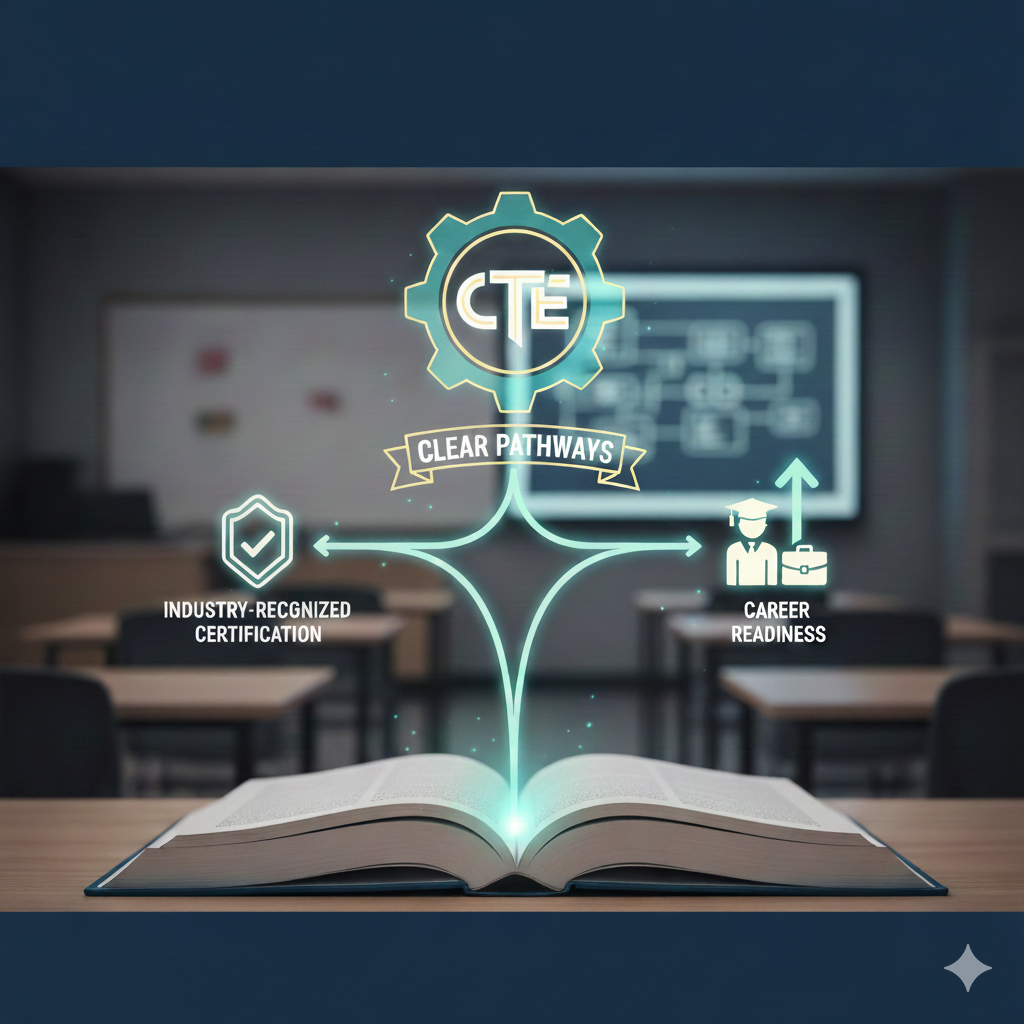
Jill mentioned an important nuance:
“Not every course is going to end in a certification… if it’s a third or fourth year, then it’s got to be an equal, yes—standards match and certification match.”
Introductory courses can be more flexible. But upper-level CTE programs live or die by:
- Industry-recognized certification alignment
- Certification pass rates
- Clear connections to work-based learning and actual roles in the region
National guidance on work-based learning describes it as connecting school to “real work” experiences that prepare students for future careers. Smart vendors make it obvious how their curriculum supports that with:
- Concrete projects, scenarios, and local industry partnerships
- Clear paths from classroom to WBL experiences (internships, industry visits, etc.)
- Certification outcomes that are realistic, not inflated
When you do get time with a CTE director, Jill’s advice is blunt:
“Show me proof that you are aligned. Show me proof that you have an 85–100% pass rate on certifications for that area and program of study, and proof that other schools have said you have great tech support.”
3. Teacher-Usable, Tech-Approved, Accessible Implementation
The third non-negotiable isn’t glamorous, but it’s decisive:
- Can teachers actually use your product?
- Can the district tech team actually support it?
- Can diverse learners actually access it?
Jill looked for curriculum that:
- Supported English and Spanish when possible, especially in AZ/TX contexts.
- Included accommodations for students with IEPs and 504s.
- Offered differentiation so “students that are very bright… can move ahead” while others get more support.
In other words, accessibility and differentiation weren’t add-ons; they were baked in. On the tech side, one sentence from Jill should be written on your product roadmap:
“It’s great to have a great product, but if your tech director is not going to let you open their site, oh, wow...”
If your go-to-market strategy doesn’t proactively address data privacy, SSO, LMS integration, and support, you’re asking CTE directors to take a risk.
How CTE Directors Actually Discover Vendors (Not Your SDR’s Sequence)
.webp)
Most vendor outreach assumes that CTE directors primarily discover products through email sequences or cold calls. Jill’s reality was almost the opposite. If you’re rethinking how email and outbound should actually work in K–12 and CTE, I go much deeper on ethical outreach and opt-in programs in EdTech email marketing: the executive guide to opt-in programs vs. ethical cold outreach in K-12.
CTE Conferences as Discovery Engines — Especially ACTE CareerTech VISION
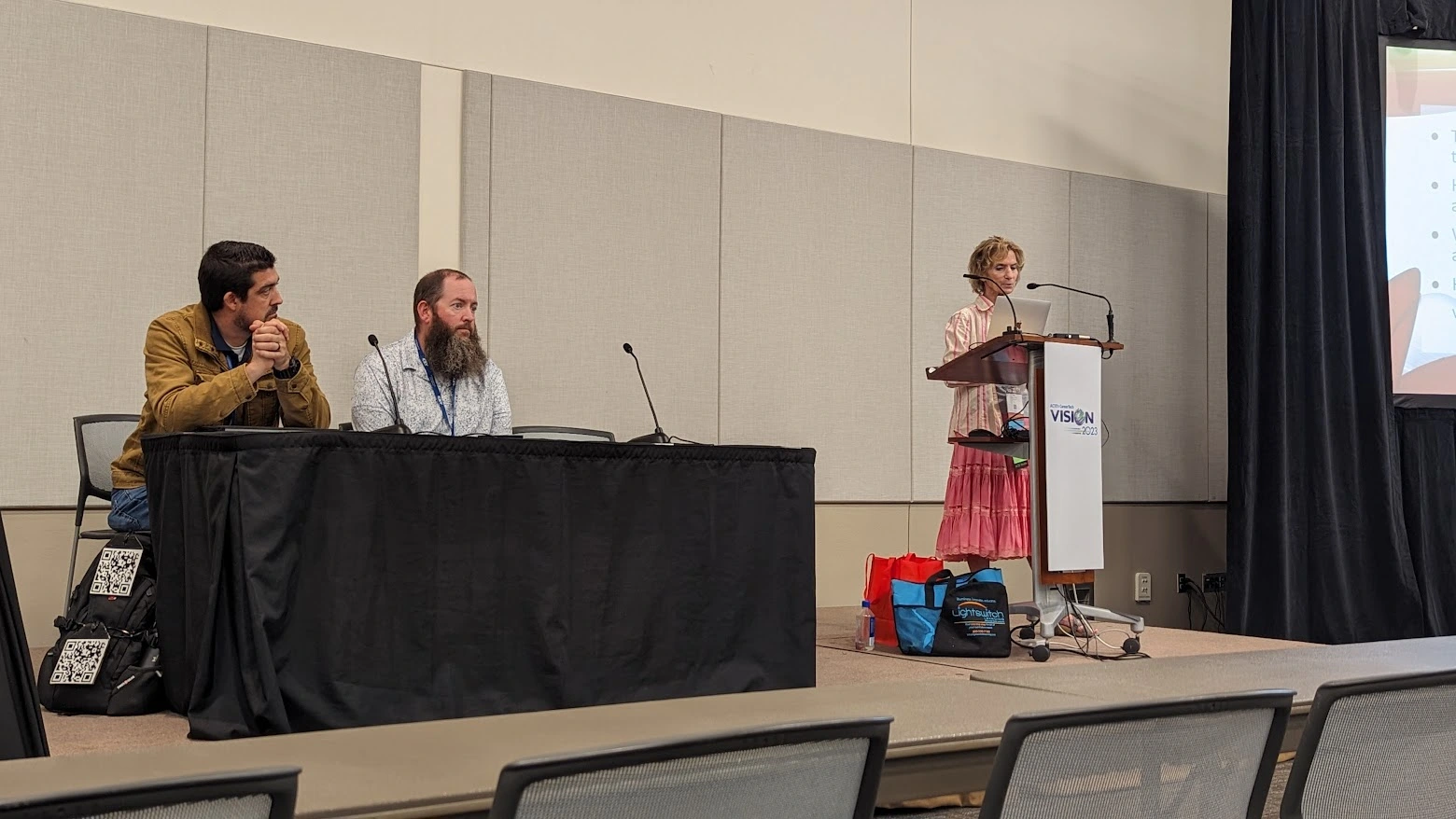
Jill found many of her vendors at CTE conferences, especially large gatherings like ACTE’s CareerTech VISION, which ACTE itself describes as the “must-attend event for career and technical education professionals,” with an expo, hundreds of concurrent sessions, and extensive networking.
Her approach to the expo was targeted:
“I would go to the expo hall and pick up brochures or talk to the vendors that I knew we needed curriculum in for different areas, and I would bring back to my teachers, not swag, but actual brochures or information regarding the product.”
State and regional CTE conferences (like AZ ACTE, or California’s Educating for Careers conference) play a supporting role, especially for regional implementation and networking. If you’re a lean EdTech team deciding how to balance national shows with state and district events, I break down that event strategy in more detail in Be the Bigger Fish: Why Lean EdTech Teams Should Skip Mega Conferences and Own State & District Events. But if you’re budgeting for one major conference where CTE directors actively look for solutions, ACTE's CareerTech VISION is your best bet.
Your Website Is Your Second Expo Booth: SEO and Landing Pages for CTE Directors
Jill shared one of my favorite stories from the interview:
“I was having trouble finding curriculum for my IT class… I actually went online and found a very unknown vendor… through Google searches, and I must have spoken to him six times and had several Zoom meetings.”
That small vendor won the business because:
- Their product matched about 80% of TEKS for that IT course (the best option available).
- Jill could understand their alignment and value from their website.
- They were willing to go in-depth on video calls to answer her questions.
If your web presence doesn’t make life easier for a CTE director like Jill, you’re forcing them to do extra work, and they will move on to a vendor who doesn’t.
Teacher Buy-In: The Real Origin of Many Deals
Another reality that vendors often underestimate: teachers frequently discover and champion products first. Jill was very clear:
“If I knew the teacher was interested and they were going to actually use it, then I would say yes [to a pilot]… If I knew they weren’t going to be willing to try it, why bother?”
In her process:
- Sometimes she researched vendors and handed teachers 3–4 options to review.
- Other times, teachers brought products to her for review.
- In both scenarios, teacher voice was central to whether a product moved forward.
If your marketing ignores teachers, if your messaging doesn’t make sense to them, or your pilots are designed around admin timelines instead of classroom realities, you’re making it harder for the CTE director to say yes.
Inside the CTE Buying Journey — From Discovery to Requisition
Within her districts, Jill described a straightforward approval process:
“I write a requisition for the number of licenses we want, for the number of years that we’re going to invest in it…”
For curriculum:
- Jill usually had final authority as the CTE director.
- Board approval only kicked in at higher thresholds, especially for equipment (e.g., above ~$25–30K).
For funding:
- In Texas, state textbook funds for certain subjects/CTE areas could pay for multi-year licenses, separate from her core CTE budget.
- In Arizona, there wasn’t the same textbook funding structure, so Perkins V and local funds played a bigger role.
On timing, Jill personally budgeted year-round—she’s comfortable with finance. But she noted:
“A lot of CTE directors will exhaust their funds in the fall… early fall, yeah.”
For your GTM, that means:
- Treat late summer and fall (and the run-up to ACTE CareerTech VISION) as prime decision windows.
- Use spring to build awareness, collect teacher interest, and align pilots so you’re not showing up cold when budgets are already spoken for.
What Kills Your Chances With CTE Directors

When I asked Jill what immediately hurt vendors’ chances, she didn’t mince words.
Walk-In Sales Tactics and “Used Car” Behaviour
“Being pushy. Acting like used car salesmen, trying to just walk into my office without an appointment… my admin assistants knew that was a huge no-no.”
Cold emails? She considered them largely harmless—easy to delete. Cold walk-ins? Relationship-killers.
If your field rep strategy still includes “drop by and see if the CTE director is available,” you’re signalling that you don’t respect their time or process.
Weak Standards and Certification Claims
Any hint of fuzziness around CTE standards or certification outcomes was a red flag.
If you can’t answer, in 10 minutes:
- Exactly which CTE standards and k-12 standards you’re aligned to
- How your product supports industry-recognized certifications (or why it doesn’t, in intro courses)
- Where your product fits within CTE pathways and work-based learning
…then you’re relying on charisma where rigor is required.And if your messaging still sounds like a generic “K–12 solution for everyone,” you likely have a positioning problem, not just a sales problem. I unpack that broader challenge in EdTech Positioning: The 2025 Playbook for K-12 CEOs.
Ignoring Teachers in Your Pilot Strategy
Jill rarely piloted ad-hoc products because she and her teachers did heavy research. When pilots did happen, they were tightly teacher-driven.
If you’re pushing pilots into classrooms where teachers aren’t interested, or if your pilot structure adds friction (extra logins, unclear expectations, no PD), you’re positioning CTE directors to avoid your brand.
Ready to Turn These Insights Into a Concrete GTM Plan?
In this article, you’ve seen how one CTE director in AZ and TX thought about standards, funding, conferences, and teacher buy-in. In Part 2 of this series, I translate those insights into an actionable playbook for EdTech and CTE vendors:
- A 10-minute meeting structure for CTE directors
- A CTE-ready go-to-market framework
- A readiness checklist you can run before your next conference or pilot
👉 Read Part 2: A Go-to-Market Playbook Based on What CTE Directors Really Want


.svg)