

The K-12 inbox is tougher than ever as educators in the US struggle to stay above water as endless pitches and demo requests fill their spam folders. District filters are more hypersensitive than ever to phishing and bulk senders; Gmail and Yahoo added stricter authentication, complaint-rate (<0.3%), and one-click-unsubscribe requirements for bulk senders; and educators have less patience for vendor spam that ignores their calendar and important context.
In this guide we separate what each email type is for, take a firm stance on purchased lists, and show how you can run inbox-safe education email marketing programs, both opt-in and ethical cold outreach, that actually create conversations with the right people at the right time.
The four types of email marketing (and what they’re actually for)
1) Promotional emails (opt-in)
Purpose: launches, offers, webinars, product and feature updates sent to people who explicitly opted in.
Key Highlights: clear value prop, frequency control, and compliant opt-outs. Gmail and Yahoo now expect authenticated mail (SPF/DKIM/DMARC) and low complaint rates from bulk senders, or your messages risk going to Promotions/Spam tabs or outright rejection by k-12 district filters.
2) Newsletters (opt-in)
Purpose: sustained trust and thought leadership (e.g., district case sudies, funding alignment explainers, evaluator checklists, relevant articles and resources).
Key Highlights: role-based segmentation (teacher leads vs. school leads vs. district admins), consistent cadence, minimal sales language, and explicit value to the district’s mission (student outcomes, equity, standard alignments, budget considerations).
3) Transactional emails
Purpose: account notices, password resets, usage reports, renewal confirmations.
Key Highlights: important updates or communications that are functional and narrow in scope. Don’t smuggle promos into transactional messages; that can change legal classification and trigger CAN-SPAM compliance issues. Include your postal address and a working opt-out for commercial components.
4) Retention & re-engagement
Purpose: marketing-qualified lead nurture, win-back sequences and “we miss you” nudges for lapsed users or trial accounts.
Key Highlights: respectful cadence, clear value, limited timerframe before purging inactive contacts to protect domain health and email list hygiene.
Opt-in programs (promos + newsletters) are your compounding asset. Transactional and retention flows protect and extend customer value. Cold email (covered below) is a different channel with different rules and risks.
Cold email is not a “type” of marketing email; it’s a separate channel.
Treat it with distinct infrastructure (auth + warmup), hygiene, and ethics. Use it for precise outreach to the right role at the right time, never as a substitute for opt-in programs. Keep reading for an in-depth explanation of cold email outreach to k-12 school districts.
Opt-in vs. cold email: different channels, different rules
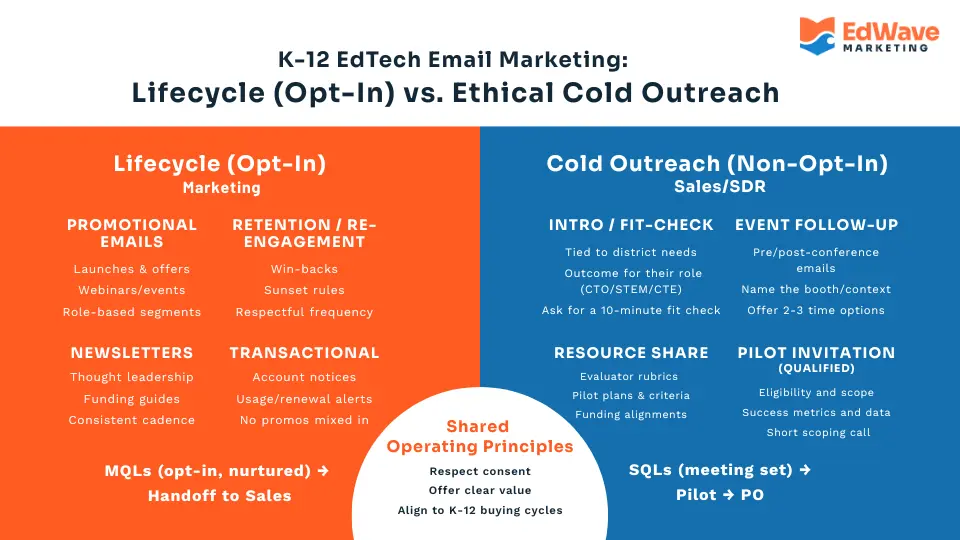
Opt-in programs thrive on consent and recurring value. Build them with lead magnets educators actually want: evaluator rubrics, pilot planning worksheets, state-specific funding explainers, and 1-pagers aligned to procurement criteria. Over time, opt-in becomes your moat.
Cold email is permissionless outreach to a specific role (e.g., CAO/CIO, Principal, CTE Director) when you have a high-confidence about product/market fit, the value of the resources shared, and timing. In K-12, ethics and precision matter: keep messages short (<120 words), problem-led, offer value, and follow with a low-friction next step (e.g., “Would a 10-minute fit check help before RFPs open in February?”). And keep complaint rates well under 0.3% since Gmail/Yahoo track this, and poor performance damages placement for everyone at your organization.
Purchased K-12 email lists are fundamentally unethical and operationally risky
.webp)
Here’s the stance we recommend to executives:
- Ethics & trust: Buying K-12 education email lists undermines the foundation of consent and respect that districts expect from ethical vendors, especially in an environment where phishing is one of the big vectors of cyber attacks against schools.
- Deliverability risk: Purchased lists are notorious for containing spam traps (or honeypots) and stale email addresses due to a high rate of turnover in education. Add these to the high potential for spam reports and complaints from educators and you get a fast path to being blocked and ruining your domain reputation, not to mention sabotaging potential district relationships. Also, most major ESPs explicitly prohibit third-party or purchased lists.
- Legal & compliance: In the U.S., CAN-SPAM does allow most marketing emails. However, you must identify yourself honestly, avoid deceptive tactics, and include an easy way to unsubscribe. But even if sending unsolicited marketing emails to educators is legal, it’s often a bad idea because district filters are strict, expectations are higher, and teachers are already under heavy pressure.
When using purchased lists is unavoidable, handle the data with care and ensure an ethical approach: verify, personalize, offer value, and make opting out effortless, never treat it like a list to email blast whenever your pipeline needs a boost. Verify every email address (use tools like MillionVerifier), enforce instant one-click unsubscribe, and keep complaint rates near zero. Authenticate (SPF/DKIM/DMARC), update your DMARC policy as you mature, use domain and inbox warmup services, and ramp volumes slowly. These are now must-haves for inbox placement with Gmail/Yahoo.
Better alternatives to purchased lists: capture leads at events or purchase lists of attendees from conference organizers, leverage regional associations such as BOCES/ESAs, pay for placement in reputable newsletters for educators, enrich only where consent and usage allow, and ask for referrals from existing district customers.
Cold email done right: the K-12 deliverability stack
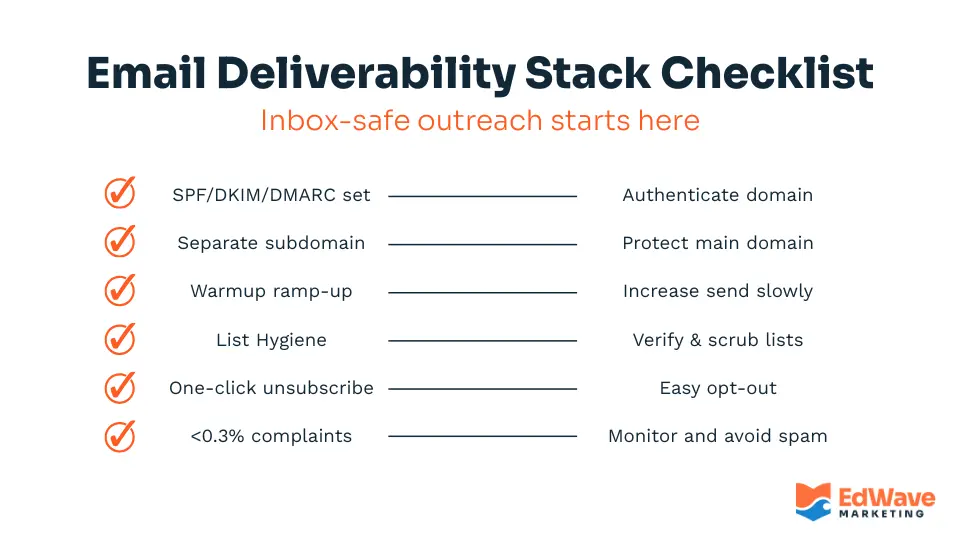
To minimize risk, ensure deliverability, and scale sustainable cold email outreach, see the steps below.
- Authenticate your domain(s). Set up SPF, DKIM, and DMARC before serious sending. Consider BIMI once DMARC is in place. Use a distinct subdomain or lookalike domains for cold outreach to protect your primary domain's reputation.
- Warm up gradually. Let your domains mature and ramp up daily send volume over multiple weeks for new email accounts. A/B test highly personalized messages and prioritize human replies. Gmail/Yahoo monitor complaint rates and engagement, so don’t exceed thresholds or send emails erratically.
- Practice list hygiene. Verify addresses, suppress role-aliases (info@, help@), and scrub hard bounces immediately. Re-verify quarterly. ESPs and ISPs interpret bounces/complaints as sender quality signals.
- Honor opt-out instantly. CAN-SPAM requires a working opt-out and bulk senders must support one-click unsubscribe.
- Right person, right timing. Map to U.S. buying windows (RFP cycles, board calendars, budget adoption) and state/district conference seasons. Coordinate with IT concerns, districts are on high alert for email threats, so clarity and legitimacy matter.
- Interoperability & privacy proof. Link to short, plain-English sheets on SIS/LMS fit (1EdTech OneRoster/LTI), DPAs, and data protection posture. This reduces friction with reviewers and IT.
- Copy that earns replies (≤120 words).
- Line 1: District-relevant problem or trigger (state mandate, assessment shift, staffing constraint).
- Line 2: Micro-proof (“Districts like X used Y to reduce Z by 21%.”)
- Line 3: Low-friction ask (“Open to a 10-minute fit check before your spring RFPs?”)
- PS: One resource (evaluator rubric, funding source explainer, or a pilot plan), not a brochure.
- Line 1: District-relevant problem or trigger (state mandate, assessment shift, staffing constraint).
Case study: 20% positive replies for a national STEM & CTE provider
A national CTE/STEM curriculum provider faced declining replies and inconsistent inbox placement. EdWave Marketing re-built their email marketing approach with domain authentication & warmup, strict hygiene and verification, and role-based messaging aligned to the needs of CTE directors and principals. We paired each message with a district-ready resource (pilot success criteria and evaluator checklist) and timed sends to pre-budget windows.
The result: 20% positive reply rate and a steady stream of meetings for the organization’s sales team, without any emails going to spam.
Email marketing metrics that matter (and what to ignore)
- Watch: reply rate, meeting-set rate, spam complaint rate (<0.3%), hard bounce rate, domain reputation signals, pilot to PO conversions, and sales cycle time.
- Disregard: raw open rates (skewed by district filters and Apple MPP). Even link-clicks aren’t completely trustworthy, but human replies are your north star.
Your 30-day executive action plan for email marketing to educators
Week 1: Hygiene & compliance baseline
- SPF/DKIM/DMARC live; List-Unsubscribe headers or signature configured.
- Set up and age lookalike domains for cold; prep ongoing email deliverability testing to a seed list (emails you own)
- Suppression rules for role aliases (don’t send to webmaster@, hello@, admin@ emails), email verification pass; remove hard bounces.
Week 2: Role & value mapping
- Buying-committee map and contact list (CIO/CAO, Principal, CTE Director, Asst. Superintendent, etc.).
- Build a 3-asset pack: evaluator rubric, pilot success template, district one-pager (privacy + interoperability).
- Deploy email accounts on the lookalike domains you set up in week 1 (3-4 accounts per domain as a rule of thumb)
Week 3: Sequences & QA
- 3–4 step sequence (value → micro-proof → reminder → break-up). Minimize links, avoid images, and skip attachments (one link to a value-adding resource).
- Launch email inbox warmup, ramping up to 30-40 email sends per day, per account.
Week 4-5: Launch & iterate
- Test across 10–20 hand-selected contacts; monitor engagement and complaint rate.
- Ramp gradually and follow up with replies daily.
- Create rules for purging non-responsive contacts. Plan for quarterly list re-verification.
Bottom line
Opt-in programs compound attention and trust. Ethical cold outreach creates new conversations when timing and role fit are right. Purchased lists remain fundamentally unethical and risky. If your leadership insists on third-party data, handle with care: use trusted data providers, verify aggressively, honor opt-outs instantly, and run strict deliverability controls, or you’ll pay with real-world district reputation and long-term domain damage. What’s the worst that can happen? Imagine your next email follow-up with an existing customer, or even a quick email to a coworker, going to spam without your knowledge.
FAQ
Is cold emailing schools legal in the U.S.?
Generally, yes, under CAN-SPAM if you follow rules (accurate identification, working opt-out, prompt honoring. Keep in mind that “legal” does not equal “welcome” in K-12. Many districts heighten filtering due to phishing risk; ethical, value-led copy is essential. What’s the fastest way to land in Spam?
Sending unauthenticated bulk mail, high complaint/bounce rates, using purchased lists, and foregoing one-click unsubscribe for bulk sending.
Can we buy a list “just to get started”?
We advise against it. It’s fundamentally unethical in K-12 and often violates ESP policies. If leadership insists on third-party data, require legitimate data providers, verify ruthlessly, and send slowly with one-click unsubscribe and airtight authentication.
What should our cold email look like?
≤120 words, one clear problem, one micro-proof, one low-friction ask, one link to a relevant resource. No attachments. Honest subject line and signature.
Which metrics matter most?
Reply rate, meeting-set rate, complaint rate (<0.3%), hard bounces, pilot to PO conversions, sales cycle time.


.svg)