

EdTech Positioning That Wins: Focus Beats Features in K-12
Most EdTech startups don’t lose because their features are bad. They lose because their positioning is fuzzy; trying to be many things to many buyers, then compensating with bundles, freebies, or “feel-good” stories. In a post-ESSER market with tighter budgets and tougher chains of approval, the companies that own one problem for one buyer will outpace generalists on price, product quality, pipeline, and adoption.

Why positioning decides winners in K-12 EdTech (not features)
Post-ESSER reality raised the bar. ESSER III obligations ended September 30, 2024, with liquidation windows closing January 30, 2025. Districts are re-evaluating vendors amid fiscal cliffs and program cuts, which means your story must be precise: who is your product for, what does your product solve, and what outcomes can your buyers defend and advocate for in a budget meeting.

“Serve every master” quietly dilutes your advantage. Positioning experts have long warned that broadening to please more buyers undermines your ability to dictate prices and be chosen on expertise. With a narrow focus, your evidence compounds; when you spread too thin, your proof is scattered and fragmented.
Focus scales better than features. Executives often default to building more features to “cover” more use cases and reach more buyers. But focus through owning a specific wedge creates clearer messaging, shorter sales cycles, implementations that stick, and customers that keep coming back. That’s classic positioning strategy wisdom: protect the core before you expand.
“Once you prove that you can't pull off being a successful generalist... go ahead and narrow to a more practical position.”
Blair Enns, CEO of Win Without Pitching
The EdTech specialization framework: one problem × one K-12 buyer × one outcome
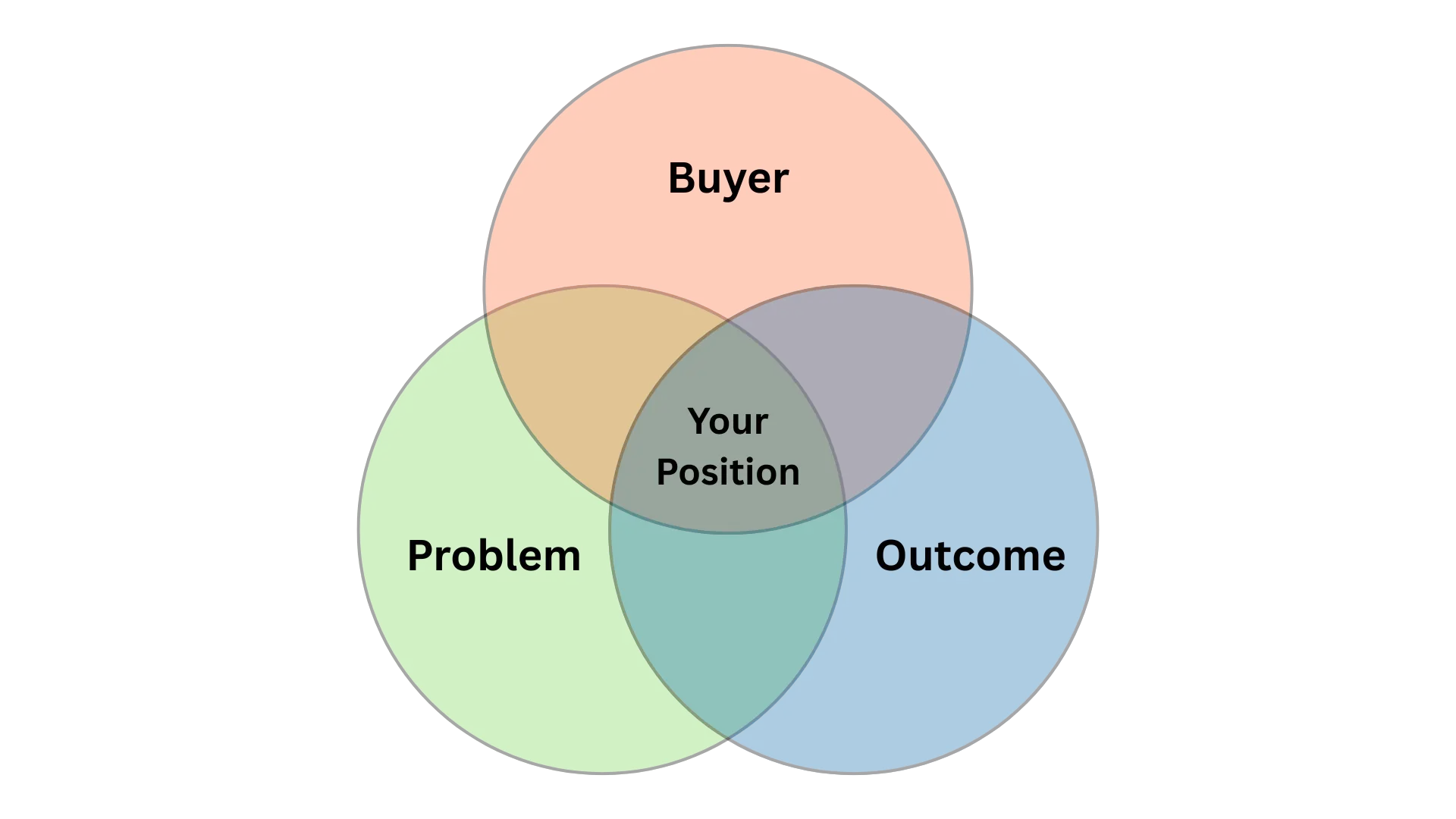
Pick the lane: The vertical of K-12 is not a position in itself; your position is a precise micro-sector, such as CTE coordinators struggling to staff CTE pathways or district IT directors needing SIS-clean rostering in 3 weeks or less. Positioning experts frame this as choosing the smallest viable market where you can be the obvious choice.
Outcome clarity beats lists of features. Administrators don’t buy features; they defend outcomes at board meetings: attendance lifts, time saved in rostering, assessment alignments, PD capacity. Your website’s headline, sales deck, and prospecting emails should present the measurable results first, and then the process after.
Price power follows tight positioning. As veteran sales coach and positioning expert Blair Enns notes, broad positioning invites price comparison, while narrow positioning reduces comparables and increases your ability to set the terms of your engagement.
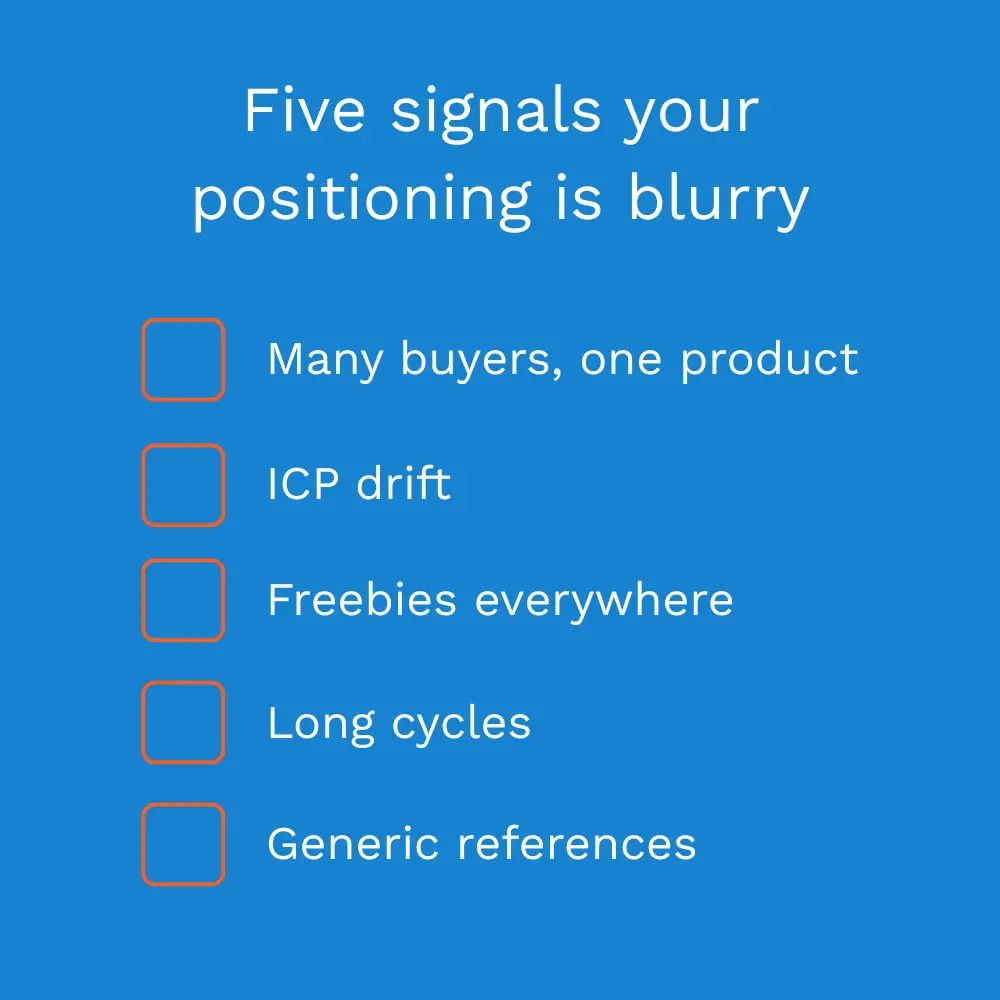
Five signals your EdTech marketing positioning is blurry
- Many buyers, one product.
Your site speaks to teachers, principals, C&I, and IT, each with different success criteria. That confuses K-12 buyer committees. - Your Ideal Customer Profile (ICP) drifts from slide to slide.
Example: the homepage targets district C&I leaders, but mid-deck you pivot to IT directors, and the pricing page speaks to teachers. This leaves buyers unsure who you built the product for. - Freebies everywhere.
Discounts, bundled add-ons, pilots without criteria, and “starter SKUs” meant to unblock deals are all signs you’re compensating for a weak product-market fit. - Longer cycles, more last-minute blockers
Broad messaging invites extra approvers (privacy, IT, PD). Each added reviewer adds new requirements and slows the deal. - Generic references don’t match the buyer.
If you’re selling to IT but your proof points are from classroom teachers, the story won’t convince the IT lead or their cabinet.
Mini-case in EdTech marketing: from sharp to shapeless
A K-12 curriculum provider launched with a crisp position: one grade band, one subject, one buyer (C&I), one outcome (standards-aligned units teachers actually implemented). Growth was strong.
Then came adjacent markets. Leadership pushed into multiple subjects and buyer types (SEL, assessment, even IT-adjacent tooling). Product quality slipped outside the core; messaging tangled; PD burden rose. Pipeline swelled, but win rates fell drastically, discounts & add-ons climbed, and implementations lagged.
The fix wasn’t “more features.” It was re-focusing and re-narrowing:
- Drop two segments and sunset weak or outdated SKUs.
- Reclaim the original Ideal Customer Profile (ICP) and problem statement with strong proof speaking to results.
- Time-boxed pilots with success criteria and board-ready outcomes.
- Build K-12-buyer-committee-friendly collateral: privacy posture, interoperability readiness (e.g., OneRoster alignment), PD plan, and district-relevant references/case studies.
Within one quarter, early signals should improve: higher reply rates, more meetings turning into opportunities, fewer discounts, and faster implementations as PD and setup are designed for one single clear use case.
Build a position that K-12 districts can actually buy
1) K-12 district-literate messaging
Tie your positioning to the real factors that often derail late-stage deals (procurement rules, funding fit, data privacy, interoperability, PD capacity)
- Procurement path: Is this an RFP, a bid, or a sole-source purchase? Say which one up front
- Funding fit: Tie your products’ outcomes to the specific funding sources leaders have access to post-ESSER (Title I, state grants, local). Budget pressure is real for districts, so acknowledge it.
- Privacy & interoperability: Say how you handle data (agreements, DPAs) and name the standards you align with (e.g., OneRoster) so IT can check the box.
- PD & implementation: Adoption dies without capacity or staffing. Include schedules, commitments, and role clarity up front for everyone who needs to be involved.
2) Pilot-to-purchase design
Pilots aren’t freebies, but experiments with rules.
Spell out the pilot and its path to purchase: who qualifies (campuses/programs), success metrics, data collection, timeline, teacher time, PD cadence, and exactly how a successful pilot moves to a signed contract (approvals and steps).
3) Evidence that travels.
Districts usually don’t listen to anecdotes. Provide:
- Outcomes and success metrics from nearby or similar districts.
- A one-page privacy/interoperability readiness sheet.
- List who does what: the vendor contact for PD, the district contact for PD, and how teachers get help (help desk hours, ticketing, live sessions).
- A board-meeting slide with 3 bullets (need, result, cost/impact).
4) Channels that reinforce your position.
- Email: Stay respectful and compliant with your emails; align subject lines and content to role-specific outcomes (teacher vs C&I vs IT).
- Conferences: Score K-12 events ruthlessly; attend only those where your exact buyer is present and willing to evaluate.
- Partners: Lean on routes that encode your niche (state associations, C&I networks, SIS/rostering ecosystems).
Executive checklist: are we positioned well, or just busy?
Answer yes/no:
- Our Ideal Customer Profile (ICP) is one buyer with a clear problem and outcome.
- Our homepage headline states the outcome first, then the process/mechanism second.
- Our sales deck maintains the same ICP throughout (no drift).
- We have disqualification rules and can say “no” to requests outside our ICP.
- Our pricing reflects our expertise (no “starter SKUs” created to win on price).
- Our pilot has entry criteria, success metrics, and a path to purchase.
- We can hand IT a privacy/interoperability one-pager (e.g., OneRoster)
- We have role-based references that match the buyer’s context and pain points.
- Events and email reinforce the position, not dilute it.
- If budgets shrink, our value story still makes the cut.
What to do next
If your team recognizes those blurred signals, don’t add features or bundle in freebies; instead, narrow your position. Make every channel reinforce your position: website copy, email sequences, conference choices, and partner listings should all target the same buyer/problem/outcome, without detours. This is a key part of “becoming less exchangeable.” Districts call it “easy to buy.”

FAQ
1) Isn’t broad positioning safer for growth?
Counter-intuitively, breadth raises competition and discounting. Narrow positions reduce comparisons and shopping around, and increase win rates. Expand after you dominate a wedge.
2) How do we avoid losing RFPs by being “too narrow”?
By writing RFP responses that highlight outcome fit and risk reduction (privacy/interoperability/PD). Committees prefer a sure win in one area to a vague solution that covers many areas.
3) What proof convinces a cabinet or board?
Role-based outcomes from similar districts, pilots with set timelines tied to results, and a one-page privacy/interoperability brief make the impact across committees and chains of command.
4) How does post-ESSER change our GTM?
Expect tighter budgets and more scrutiny. Focus on sharpened outcomes and funding alignments. Generalist solutions get cut first.


.svg)