

The demo never gets scheduled. That’s the real problem.
Most EdTech vendors spend months perfecting their product walkthrough… refining the slide deck, scripting the feature highlights, training the sales rep on objection handling. Then they send a cold outreach to a Director of Technology, ask for “20 minutes of your time,” and hear nothing back.
Or worse, they get the meeting, run the demo, and lose the deal to a vendor with a potentially inferior product.
This is not a problem with the demo. It’s a problem with the go-to-market. And after eight years of leadership in K-12 EdTech, countless conversations with founders, and over a hundred trade shows and conferences, I can tell you: the pattern is remarkably consistent.
The Market Got Harder. Most Vendors Didn’t Adjust.
Here’s the landscape right now. ESSER obligation deadlines hit in September 2024, and districts are back to recurring funding sources — Title I ($18.4 billion annually), Title II-A for teacher quality and professional development (~$2.19 billion), Perkins V for CTE, Title IV-A SSAE for technology and enrichment, 21st CCLC for out-of-school-time programs, and state-level funds like California’s Expanded Learning Opportunities Program (ELO-P), which has grown to roughly $4.5 billion for afterschool and summer enrichment. Each with its own compliance requirements, allowable uses, and procurement timelines. Only 6% of states have plans to continue ESSER-funded EdTech initiatives in 2025, down from 27% in 2024.
That’s not a dip. That’s a cliff.
Districts aren’t cutting EdTech entirely, but they’re consolidating hard. Over half of schools use 10–15 different educational apps regularly, and they’re collapsing everything into unified ecosystems while demanding proof of impact before they’ll even take a meeting. States like Utah, Missouri, Alabama, and Tennessee are actively formalizing policies around EdTech safety and effectiveness. The 2026 EdTech Evidence Report from Instructure and InnovateEDU puts it plainly: “Procurement scrutiny is rising,” with state and district leaders building more structured evaluation methods. The era of “let’s try it and see” is over.
Meanwhile, the typical district-level EdTech sales cycle runs 6–18 months, involves multiple stakeholders across curriculum, IT, finance, and sometimes the school board, and often requires board-level approval for anything above a modest threshold. That’s the reality vendors are selling into. And most of them are still leading with a product demo.
The Three Pre-Demo Failures I See Over and Over
1. The Messaging Doesn’t Match the K-12 Buyer
I’ve reviewed collateral from dozens of EdTech companies, and the same mistake shows up constantly: the messaging is built for a persona that doesn’t exist.
A vendor selling CTE curriculum will build their entire pitch around “preparing students for the future of work,” which sounds great in a board meeting, but a CTE director evaluating your product wants to know which Career Clusters you support, whether your curriculum maps to their state’s CTE standards, and if it leads to industry-recognized certifications. They’re not buying a vision. They’re buying a solution that fits inside a system they’re already accountable to.
And it gets worse. I’ve seen intake forms that assume every buyer is a district (“District Name” as a required field) when private schools, charters, and after-school programs are significant buyer segments. I’ve seen social proof that references districts in completely different states and contexts. I’ve seen product pages that lead with a feature list when the buyer’s first question is about compliance.
The messaging doesn’t fail because it’s bad writing. It fails because nobody talked to the actual buyer before writing it.
2. Education Conference Strategy Is Backwards
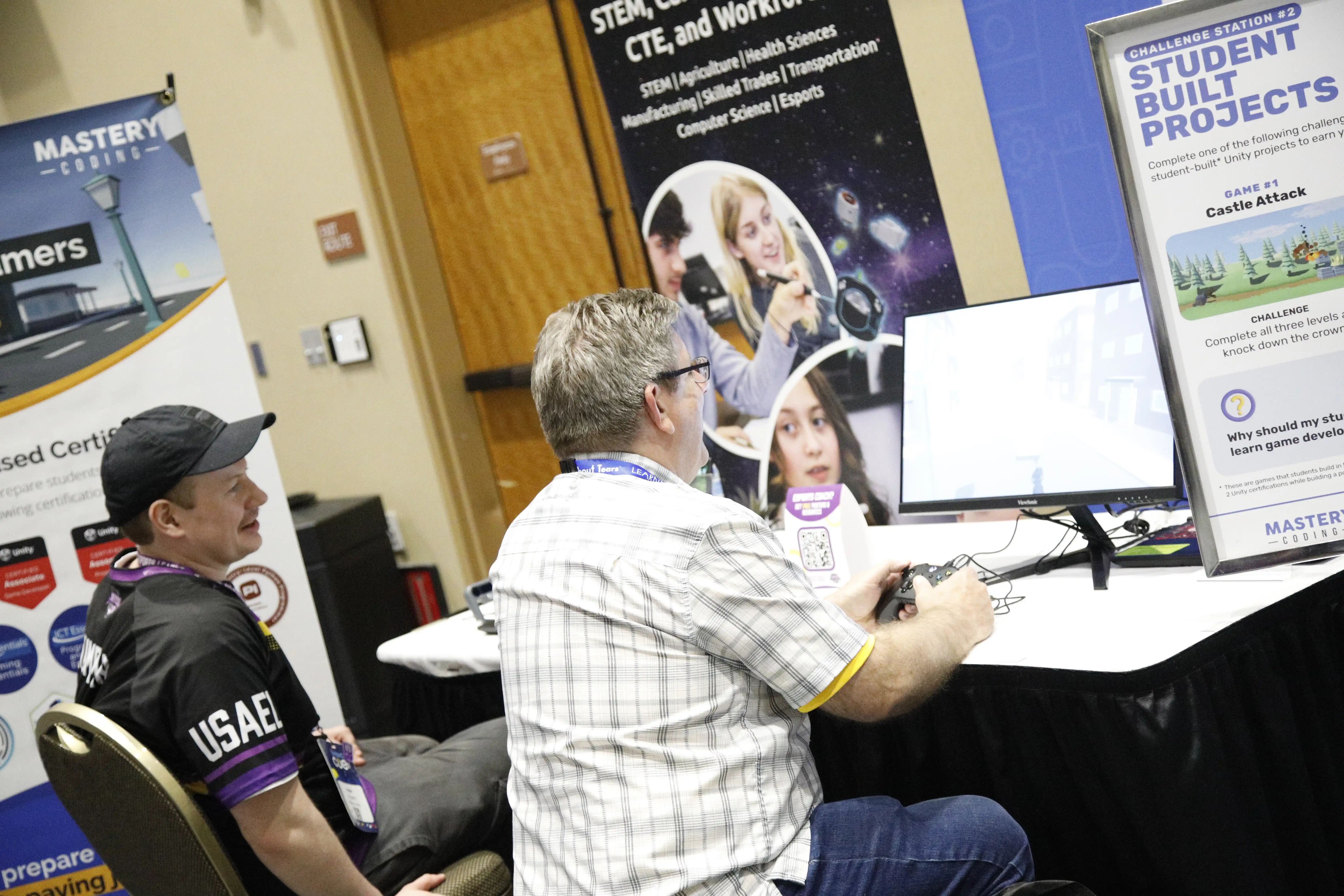
I’ve staffed and managed booths at everything from ACTE’s VISION to ISTE to FETC to BOOST. And the pattern at most vendor booths is the same: badge scan, launch into demo, hope for a follow-up.
That’s exactly backwards. Conferences are confirmation channels, not prospecting channels. The buyers who matter (Asst. Superintendents of C&I, CTE directors, directors of technology) already know what they’re looking for before they walk the expo hall. They’ve done their research. They’re checking boxes, not discovering products.
The vendors who win at conferences are the ones who’ve done the pre-work: they already know which attendees match their ICP, they’ve made contact before the event, and their booth conversations are qualification-focused (not demo-focused). Their collateral is tailored to the specific conference audience (a CTE-focused flyer for ACTE, an after-school one-pager for BOOST… not the same generic handout for every show). Their follow-up sequences are built and loaded before the conference starts, just waiting for contacts to be dropped in. And ideally, their team has someone delivering a presentation or running a workshop because nothing builds credibility faster than having a speaker on the agenda, not just a booth on the floor.
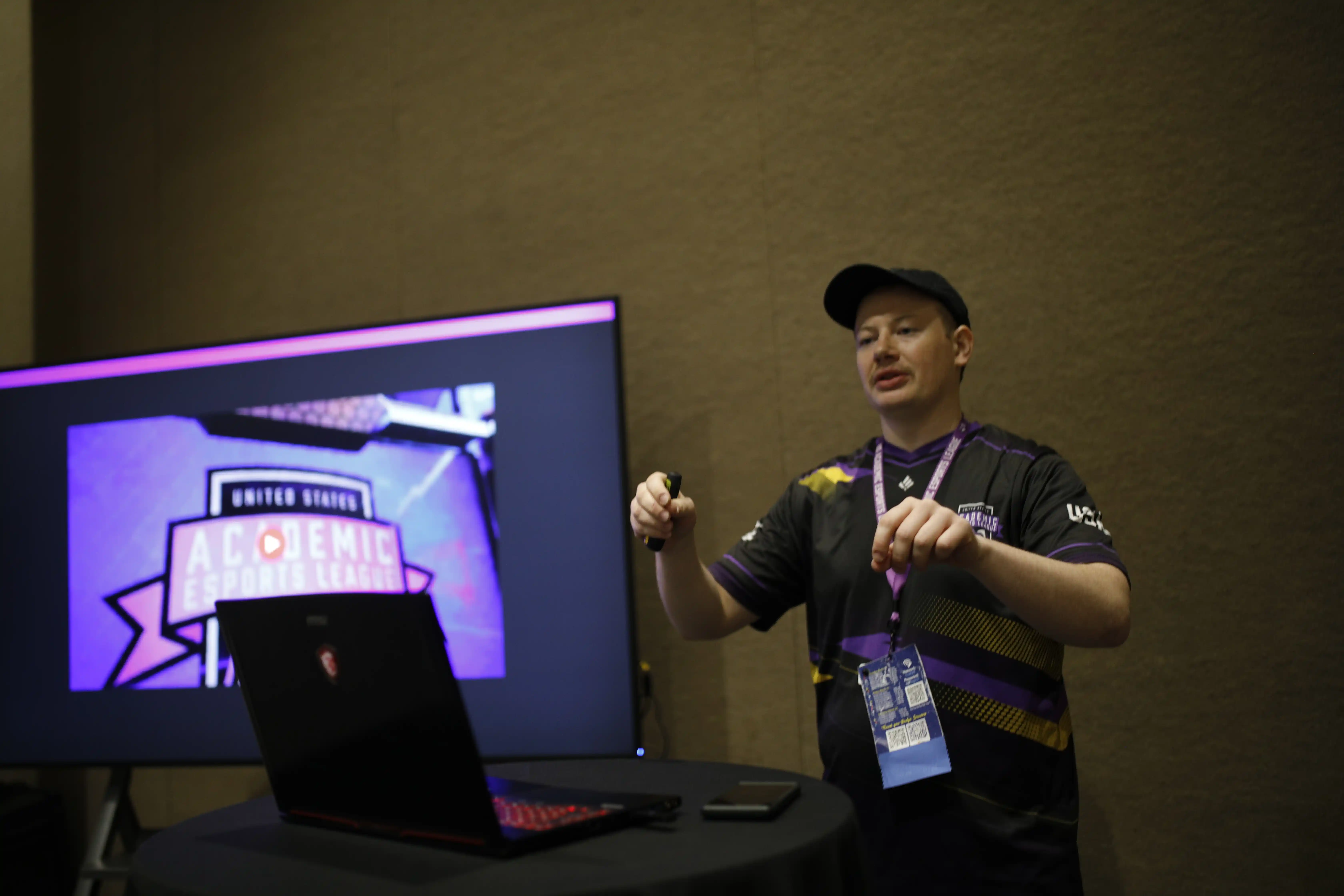
When we shifted to this approach and implemented rigorous show selection, engaging booth design built for conversation (not presentation), audience-specific collateral, and structured post-event follow-up, we grew total sales from events by 55% year over year, with fewer conferences attended.
3. Nobody’s Done the Compliance Homework
Here’s where the procurement reality matters, even from a GTM lens. A district CTO evaluating your platform isn’t starting with “Is this product impressive?” They’re starting with:
- Does this qualify under our funding source?
- Will this create a FERPA problem?
- Does it integrate with our SIS (Infinite Campus, PowerSchool, Clever)?
- Can I defend this purchase in a formal evaluation?
FERPA compliance and SOC 2 certification aren’t differentiators anymore. They’re the minimum to get through the door. And the bar is getting specific. That same Instructure/InnovateEDU report reviewed 150 of the most-used classroom technologies and found that only 33% of purpose-built EdTech tools have even one data compliance certification, only 30% have an interoperability certification, and just 40% have any identifiable ESSA evidence level. Those are the numbers for companies designed for education. If you’re an early-stage vendor without these basics documented and visible, you’re getting filtered out before a human being ever reads your outreach.
The vendors who get this right build what I call a “pre-qualification brief”: a one-page document (or a section on their website) that answers the CTO’s compliance and integration questions before they have to ask. As my podcast co-host John Faig (a middle-school tech director who evaluates vendors daily) put it on a recent episode:
Compliance and interoperability documentation is important to have upfront… trying to make my life easy and providing a uniform data dashboard for my users is something I think about all the time. And the more products you integrate with, the easier it is and the better it is for all concerned.
When we asked John whether vendors who answer those questions before he even sends his RFP have a leg up, his answer was an immediate: “Oh, for sure.”
The CTE side tells the same story. In a recent interview, Jill Ranucci, PhD (a former CTE director in Arizona and Texas for nearly 20 years) described how she found one of her best IT curriculum vendors not through a cold call or a trade show, but through deep Google searches. That vendor won the business because Jill could evaluate their standards alignment and value from their website before ever picking up the phone. Her bar for even considering a product?
Show me proof that you are aligned. Show me proof that you have an 85–100% pass rate on certifications… and proof that other schools have said you have great tech support.
If that proof isn’t visible and accessible on your site, you’re invisible to the people who are actively looking to buy.
That signal — that you understand their world — matters more than any feature demo in a market where districts are increasingly selective.
The Pre-Demo Win Framework
Here’s what the vendors who actually close K-12 deals do differently — and when they do it.
Six months out:
This is marketing time, not sales time. Research suggests that only about 5% of your market is actively “in-market” at any given moment. The other 95% aren’t ignoring you because they don’t care — they just aren’t buying right now. That means six months out, your job is to build awareness and credibility so that when a district enters its buying cycle, you’re already on the shortlist. Content, conference presence, community involvement, thought leadership… this is the work that compounds.
At the same time, identify target districts and start tracking their RFP calendars. State procurement portals, district purchasing pages, and platforms like Frontline and EdJoin post these opportunities well in advance. If you’re discovering relevant RFPs two weeks before the deadline, you’re not selling — you’re reacting.
This is also when you confirm whether your product qualifies under the funding sources your target districts actually use. Post-ESSER, that means Title I, Perkins V (for CTE), Title IV-A SSAE (for technology and enrichment), 21st CCLC (for after-school), or state-specific grants like California’s ELO-P. If you can’t clearly articulate which funding source covers your product, your prospect’s finance team will move on to a vendor who can.
If your product has a freemium or free-trial tier, this is also the time to make a concentrated push to get classroom teachers using it. A few dozen teachers actively using a free version of your product adds real weight when the district-level conversation starts. “Your teachers are already using this” is one of the strongest arguments for a site or district adoption.
Three months out:
Map your platform’s interoperability to the district’s existing stack. If you don’t connect cleanly to their SIS (Infinite Campus, PowerSchool) or their rostering tool (Clever, ClassLink) via OneRoster or SSO, you’re creating implementation risk — and district CTOs price that risk heavily.
Build a pre-qualification brief: a one-page document that answers the CTO’s compliance and integration questions before they ask. FERPA documentation, SOC 2 status, data governance policies, integration architecture. This is not a nice-to-have. This is what gets you past the procurement coordinator who filters vendors before anyone with a title ever sees your name.
If you have outcome data from existing implementations, prepare ROI data benchmarked against comparable districts — cost per student, implementation timeline, measurable outcomes. If you’re earlier-stage and don’t have district-level benchmarks yet, compile what you do have: pilot results, usage data, teacher feedback, student engagement metrics. Districts consolidating from 10–15 apps down to unified ecosystems are demanding proof of impact. Give them whatever evidence you have before the meeting — not after.
At outreach:
Lead with funding alignment, not features. “This qualifies under your Title I budget and integrates with Infinite Campus via OneRoster” opens more doors than “Let me show you what our dashboard can do.”
Reference peer districts with similar demographics and budget profiles. Offer a scoped pilot tied to their funding timeline. Quantify total cost of ownership, not just licensing fees — districts are evaluating TCO across a 6–18 month decision cycle with multiple stakeholders involved. Your outreach (and website) needs to anticipate every question those stakeholders will ask, because if you don’t answer them upfront, a competitor will.
The Demo Is Not the Starting Line
The demo is the confirmation of homework that should already be done. If your current pipeline strategy is built around getting demos scheduled, the pipeline has a structural problem.
The districts that matter (the ones with real budget, real authority, and real procurement processes) aren’t waiting for a demo to decide if you’re worth their time. They’ve already decided, based on everything that happened before you asked for the meeting.
Fix the pre-demo problems first. The demos will follow.


.svg)